

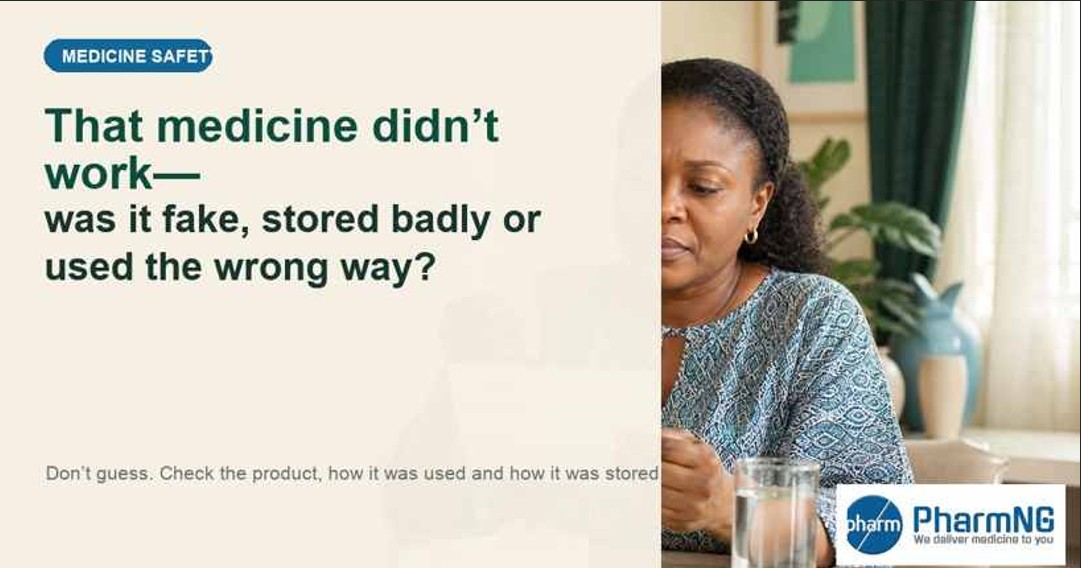
You finished the tablets, used the cream, or gave your child the syrup, but the problem has not improved. The first thought may be: “They sold us fake medicine.”
That concern should not be dismissed. Substandard and falsified medicines are a real public-health problem, and a product that does not work as expected should be taken seriously. But treatment failure does not automatically prove that a medicine is fake.
The illness may not be what you thought it was. The medicine may need more time. It may have been used differently from the directions, affected by another medicine or herbal product, or damaged by heat or moisture. The illness may also have become more severe.
Think of medicine as a key: even a genuine key will not open the wrong lock, and the correct key may fail if it is damaged or used incorrectly.
The safest response is not to double the dose, buy a “stronger” brand immediately, or combine several treatments. It is to check the facts and speak with a pharmacist or doctor.
First, what does “it didn’t work” mean?
Different medicines work on different timelines. Some are intended to relieve symptoms relatively quickly. Others work gradually or need a test or measurement to show whether they are helping.
For example, a person taking medicine for high blood pressure cannot reliably judge the effect by whether they “feel fine.” Blood pressure usually needs to be measured and reviewed. Likewise, a genuine medicine will not treat a condition it was never suitable for.
Before deciding that a medicine has failed, ask:
- What was it prescribed or recommended for?
- How soon did the prescriber or pharmacist say a benefit should begin?
- Was it taken for the advised duration?
- Were any doses missed, delayed, vomited, or taken differently?
- Is the illness unchanged, improving slowly, or getting worse?
If no one explained what to expect, contact a pharmacist or prescriber rather than experimenting with the dose.
Six reasons a medicine may appear not to work
1. The illness may not be what you thought
Different conditions can cause similar symptoms. Fever is not automatically malaria. A persistent cough has several possible causes. A rash that looks fungal to an untrained eye may be something else.
A medicine can be genuine and correctly stored but still fail because it is the wrong treatment for the actual condition. Repeating the same self-treatment or changing brands may delay the correct diagnosis.
If symptoms persist, return, or worsen, arrange a proper clinical assessment.
2. The medicine may need more time—or may need monitoring
People sometimes expect every medicine to produce a feeling they can notice immediately. That is not always how treatment works.
Ask what change you should expect, how soon it should happen, and how success should be checked. Do not continue a treatment indefinitely simply because you hope it will eventually work; follow the agreed review plan.
3. It may not have been used as directed
Real life can disrupt treatment. A dose may be forgotten during a busy workday. A caregiver may misunderstand the label. A child may spit out part of a liquid dose. Side effects, cost, work, travel, swallowing difficulty, or confusing instructions may make a schedule hard to follow.
Food, timing, and method of use can matter for some medicines. Some tablets should not be crushed or split. Some liquid medicines require shaking and an appropriate measuring device. These instructions are medicine-specific.
Do not automatically take twice as much after a missed or vomited dose. Ask a pharmacist what to do for that particular medicine.
4. Another product or health problem may be affecting it
Prescription medicines, over-the-counter products, vitamins, supplements, and herbal mixtures can interact. Food can also affect some medicines. Vomiting or diarrhea may reduce how much of a dose is absorbed.
Tell the pharmacist or doctor about everything being used—even the “blood tonic,” herbal mixture, supplement bought online, or pain medicine taken only occasionally. A complete medicine list is especially important for older adults and anyone using several products.
5. Heat, moisture, light or incorrect cooling may have damaged it
Nigeria’s heat makes storage a practical concern. Think of a medicine forgotten in a car boot during Lagos traffic, placed beside a cooker or generator, left on a sunny windowsill, or kept in a damp bathroom. Any of these may expose it to conditions outside the manufacturer’s instructions.
But the answer is not to put every medicine in the refrigerator. Some products require refrigeration; others may be damaged by incorrect cooling or freezing.
Follow the exact storage instructions on the label or leaflet. Keep medicines in their original, labeled packaging where practical and away from children and pets. If a temperature-sensitive medicine was affected by a power cut, keep the refrigerator closed where possible, note what happened, and ask a pharmacist or supplier for product-specific advice. Do not guess that it is safe or automatically discard it.
6. The product could be substandard or falsified
The World Health Organization uses two important terms:
- A substandard medical product is authorized but fails to meet quality standards or specifications.
- A falsified medical product deliberately misrepresents its identity, composition, or source.
Both may cause treatment failure or harm. However, some falsified products look almost identical to genuine ones, so appearance alone cannot prove authenticity.
Warning signs that deserve investigation include:
- Damaged or tampered packaging;
- Spelling or printing errors;
- Manufacturing, batch or expiry details that do not match between the inner and outer pack;
- An unusual colour, smell, texture or appearance; or
- A seller whose identity or physical location is unclear.
The absence of these signs does not guarantee that a pack is genuine.
How to check a medicine and where you bought it
Many Nigerians buy everyday remedies from patent and proprietary medicine vendors (PPMVs), often called patent medicine shops or “chemists.” A licensed PPMV may sell only medicines permitted by the PCN for that vendor’s license or tier—generally simple, approved remedies. A PPMV is not a pharmacy. Obtain prescription medicines from a registered pharmacy or authorized health facility.
At a pharmacy, look for the original, current PCN premises registration certificate and the superintendent pharmacist’s current annual license displayed where customers can see them. Confirm the physical address and use the Pharmacy Council of Nigeria’s pharmacist and premises verification tools (https://pcn.gov.ng/). An identifiable pharmacist should be available for counseling. No single sign proves legitimacy, so ask questions when details are unclear.
Buy from licensed pharmacies, licensed PPMVs operating within their permitted scope, or authorized health facilities. Be cautious with hawkers, informal social media sellers, and websites that hide their location.
Then check the product:
- Search the official NAFDAC Greenbook (https://greenbook.nafdac.gov.ng/) using the product name, active ingredient, or registration number.
- Confirm that details such as the product name, strength, manufacturer, and registration status match the pack.
- Compare the inner and outer packaging for inconsistent batch, manufacturing, or expiry details, damage, or tampering.
- Keep the pack and receipt if anything seems wrong. A Greenbook match supports that the product is authorized, but a printed or copied registration number does not authenticate the individual pack.
Mobile Authentication Service (MAS) scratch panels are used mainly on antimalarials and antibiotics. Their absence on many other products is not suspicious. Where a pack carries a panel, follow the instructions printed on that exact pack. A “genuine” SMS response confirms that code; it does not by itself prove every step in the supply chain. Ask a pharmacist when you are uncertain.
What to do when a medicine is not working as expected
Use this checklist:
- Check for danger first. Severe reactions or rapidly worsening illness need urgent in-person care.
- Do not double, switch, extend, or combine treatment yourself. Do not abruptly stop a prescribed medicine without medicine-specific professional advice. However, if you develop signs of a severe reaction—such as difficulty breathing, facial or tongue swelling, collapse, or a severe blistering rash—seek emergency care immediately and do not take another dose of the suspected medicine unless an emergency clinician tells you to.
- Check the label and leaflet. Confirm the correct person, medicine, strength, directions, expiry date, and expected duration.
- Review how it was used. Note missed, late, or vomited doses; food timing; measuring problems; side effects; and other medicines, supplements, or herbal products.
- Review storage. Consider unusual heat, moisture, sunlight, freezing, or a broken cold chain.
- Keep the evidence. Retain the medicine, inner and outer packaging, leaflet, and receipt. Photograph anything unusual. Do not taste, open, or crush it merely to “test” it.
- Contact a pharmacist or prescriber promptly. Take the pack and a complete medicine list and explain what was used, how it was used, and what changed.
- Report the right concern. For suspected poor-quality, falsified, or unregistered products, use the NAFDAC Greenbook reporting form (https://greenbook.nafdac.gov.ng/report/sf) or NAFDAC MedSafety (https://nafdac.medsafety.io/). For a suspected adverse reaction, use the Nigeria adverse-reaction form (https://vigiflow-eforms.who-umc.org/ng/adr). You do not need to prove the case before reporting a suspicion.
Not sure what to do next? Keep the pack and receipt, then use PharmNG (https://pharm.com.ng/) for non-emergency pharmacist support. If you use recurring medicines, MedFill (https://pharm.com.ng/medfill/) includes medication-review support. Do not wait for an online response if symptoms are severe or worsening rapidly.
When it is an emergency
Seek urgent in-person medical care for difficulty breathing, swelling of the face, lips, or tongue; collapse or fainting; a seizure; new severe confusion or unresponsiveness; a severe widespread rash, blistering, or peeling; chest pain; sudden one-sided weakness or speech difficulty; or rapid severe worsening.
Arrange prompt clinical review when symptoms persist or worsen despite treatment, repeated vomiting prevents medicines or fluids from staying down, or a young infant, pregnant person, older or frail adult, immunocompromised person, or someone with a major chronic condition is not improving.
Do not wait for an online order, social media reply, or routine delivery during an emergency.
How a pharmacist and prescriber can help
A pharmacist can examine the product and packaging, review how it was taken and stored, check for possible interactions, explain medicine-specific instructions, and help with regulatory reporting.
A doctor or other qualified prescriber can reassess the diagnosis, examine the patient, request tests where appropriate, and decide whether treatment should change.
For non-emergency medicine questions, PharmNG provides online pharmacy access and pharmacist support. Through MedFill, eligible patients using recurring medicines can also access prescription management, refill reminders, and medication reviews. These services can support safer, more organized medicine use, but they do not replace urgent in-person care or clinical reassessment when an illness is worsening.
A medicine that seems not to work deserves investigation—not accusation or guesswork. It may be substandard or falsified, but it may also be the wrong treatment, incorrectly used, poorly stored, or affected by another factor.
Not sure what to do next? Keep the pack and receipt, then visit PharmNG (https://pharm.com.ng/) for non-emergency pharmacist support. For recurring medicines, MedFill (https://pharm.com.ng/medfill/) includes medication-review support.
Medical Safety Note
This article provides general health education and does not diagnose illness or provide individual dosing advice. Do not change, double or stop a prescribed medicine without professional guidance. If you develop signs of a severe reaction—such as difficulty breathing, facial or tongue swelling, collapse, or a severe blistering rash—seek emergency care immediately and do not take another dose of the suspected medicine unless an emergency clinician tells you to.