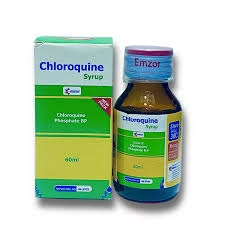

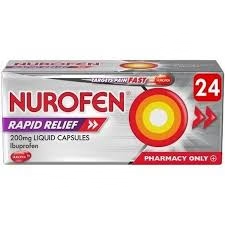



Your mother is taken to a clinic and someone asks, “What medicines does she use?” One relative remembers the blood pressure tablet. Another sends a photo of a diabetes medicine from six months ago. Nobody is sure whether the small white tablet was stopped.
That is a difficult moment to start searching family WhatsApp chats.
An up-to-date medicine list gives a patient, caregiver, pharmacist or doctor one reliable place to begin. It is useful at routine appointments, when seeing a new health professional, after discharge from hospital and during an emergency.
The World Health Organization identifies transitions such as hospital admission and discharge as important medication-safety points. WHO also notes that patient-held paper or electronic medicine records can help people track medicines and share accurate information with health workers. This is especially practical where records from different facilities do not automatically connect.
What counts as a medicine?
List everything used for health, not only prescription tablets:
- prescription medicines;
- medicines bought without a prescription;
- injections, inhalers, eye or ear drops;
- creams, ointments and patches;
- vitamins and other supplements;
- herbal mixtures and traditional remedies; and
- medicines used only occasionally, such as some pain or allergy products.
This matters because health products can interact or cause side effects. “Natural” does not mean irrelevant to a pharmacist or doctor.
The 10 details to record
For each medicine or health product, write:
- Name: copy the exact name from the labelled pack.
- Strength: for example, the number followed by mg, micrograms, units or another stated strength.
- Form: tablet, capsule, liquid, inhaler, cream, injection or other form.
- How much is used: copy the current directions; do not reconstruct them from memory.
- When it is used: include times and any food-related instruction written on the label.
- Why it is used: record the condition or reason, if known.
- Who prescribed or recommended it: include the clinic, prescriber or pharmacist where useful.
- Date started: an exact date is ideal; an honest estimate is better than a false date.
- Important problems: note suspected side effects or difficulties, but do not label something an “allergy” unless a qualified professional has assessed it as such.
- Current status: taking now, temporarily paused on professional advice, or stopped—with the date and who advised the change.
At the top of the list, add the person’s full name, date of birth, emergency contact, known medicine/food allergies and important health conditions. Ask a health professional to clarify anything uncertain.
Build it from evidence, not memory
Put all current medicine packs, recent prescriptions and discharge instructions in one place. Ask the person what they actually take—including products kept in a handbag, bedside drawer or refrigerator.
Compare the labels with the draft list. If two packs appear to contain the same medicine, if directions conflict, or if an old and new strength are both present, do not decide which one is correct yourself. Mark the question and take the packs and list to a pharmacist or prescriber.
A medicine list is an information tool. It is not permission to start, stop, split, double or replace a medicine.
Keep three useful versions
- Home copy: a clear paper copy in a known, secure place.
- Carry copy: a small printed copy in a wallet or bag, or a clear phone copy that can be reached quickly.
- Trusted-caregiver copy: shared only with the person’s knowledge and consent, unless lawful emergency arrangements apply.
Avoid posting the list in a public family group or social-media message. Medicine and health information is private. Share it only with people who genuinely need it for care.
For a parent in Nigeria and an adult child abroad, agree who updates the master copy. A simple rule works: when a qualified professional changes a medicine, the designated person updates the list, dates the change and sends the revised copy to authorised caregivers.
When should the list be updated?
Update it whenever a medicine is started, stopped, replaced or its strength or directions change. Also review it:
- before every clinic, dental or pharmacy visit;
- after a hospital admission or discharge;
- after an emergency visit;
- when a new over-the-counter product, vitamin or herbal remedy is considered; and
- periodically even when nothing seems to have changed.
Write “last updated” and the date at the top. An old list presented as current can create new confusion.
At appointments, show the list and the labelled packs where practical. Ask the health professional to confirm what should continue, what changed and what needs monitoring. The WHO *5 Moments for Medication Safety* encourages patients and caregivers to ask questions when starting, taking, adding, reviewing or stopping a medicine.
Red flags that need action—not just a list update
Seek urgent in-person care for difficulty breathing, swelling of the face or tongue, collapse, seizure, chest pain, sudden one-sided weakness, severe confusion, or a widespread blistering or peeling rash. Do not wait for an online response during an emergency.
Arrange prompt professional review if the person is unusually dizzy or drowsy, keeps falling, cannot manage the schedule, has repeated low blood sugar symptoms, is vomiting doses, or has a new symptom after a medicine change. Take the medicine list and packs to the review.
How PharmNG may help
A pharmacist can compare the list with labelled packs and prescriptions, identify questions for the prescriber, explain directions and check for possible duplication or interactions. According to PharmNG’s current MedFill page, MedFill offers medication reviews, prescription management, appointment and refill reminders, and scheduled medication delivery.
For non-emergency support, create the list first, then [explore MedFill](https://pharm.com.ng/medfill/) or visit [PharmNG](https://pharm.com.ng/). Never delay urgent in-person care while waiting for a delivery, message or routine review.
Medical Safety Note
This article provides general education, not individual medical advice. A medicine list must be verified with a pharmacist or prescriber and must not be used to change treatment independently.